Key Takeaways:
- Choline is the raw material for acetylcholine — the neurotransmitter of attention, memory, and muscle contraction — yet most adults consume about half the adequate intake.
- Subclinical deficiency shows up as a foggy drag on cognition, mild liver-enzyme elevation, and accelerated cellular aging.
- Two pastured egg yolks supply nearly half a man’s daily need; soybeans, salmon, and Brussels sprouts cover those who avoid eggs.
Choline is one of the few nutrients formally classified as essential that most adults still consume well below adequate intake. Its central job in the brain is to serve as the raw material for acetylcholine, the neurotransmitter that powers attention, working memory, learning, and the contraction of every voluntary muscle. Choline also forms phosphatidylcholine and sphingomyelin, the lipid building blocks of every neuronal membrane and the myelin sheaths that insulate nerves. Without enough dietary choline, the liver compensates partly by methylating phosphatidylethanolamine, but the synthetic capacity is limited and varies considerably by common genetic polymorphisms.
National dietary surveys have shown consistently that the great majority of American adults consume roughly half of the Institute of Medicine’s adequate intake, which sits at five hundred and fifty milligrams per day for men and four hundred and twenty-five for women. Pregnant women, vegetarians, and older adults tend to be at the bottom of the distribution. The clinical picture of subclinical deficiency is not dramatic; it is a slow, foggy drag on cognition, mild liver enzyme elevations, and accelerated cellular aging. Public-health reviews have argued for years that this is a quiet, modifiable gap.
Which foods give you enough choline?
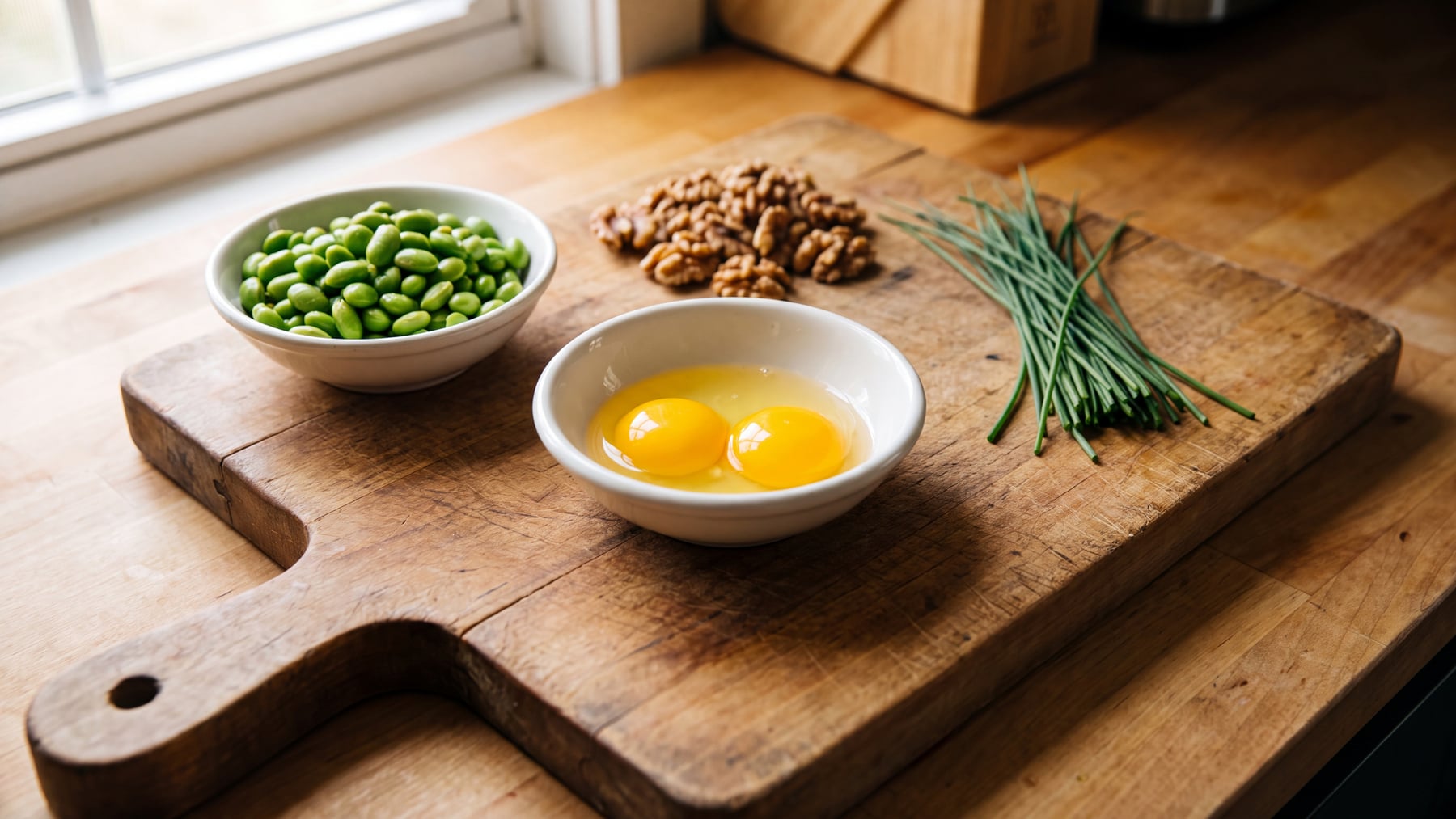
The food sources are unusually concentrated and inexpensive. Two pastured egg yolks supply nearly half of a man’s daily needs. A cup of cooked soybeans or edamame, beef liver, wheat germ, salmon, and Brussels sprouts also carry meaningful amounts. For people who avoid eggs for cardiovascular reasons, the soybean route is reliable and avoids any concern about cholesterol; for everyone else, a daily breakfast that includes eggs makes the math easy. Choline supplements exist but are rarely necessary if the plate is built thoughtfully. This is one of those quiet nutrients where pulling one item into routine eating closes a gap that no single test will flag but the brain quietly notices.
References:
- Wallace, T. C., Blusztajn, J. K., Caudill, M. A., Klatt, K. C., & Zeisel, S. H. (2020). Choline: The neurocognitive essential nutrient of interest to obstetricians and gynecologists. Journal of Dietary Supplements, 17(6), 733-752.
- Zeisel, S. H., & da Costa, K. A. (2009). Choline: An essential nutrient for public health. Nutrition Reviews, 67(11), 615-623.
Comments are closed