
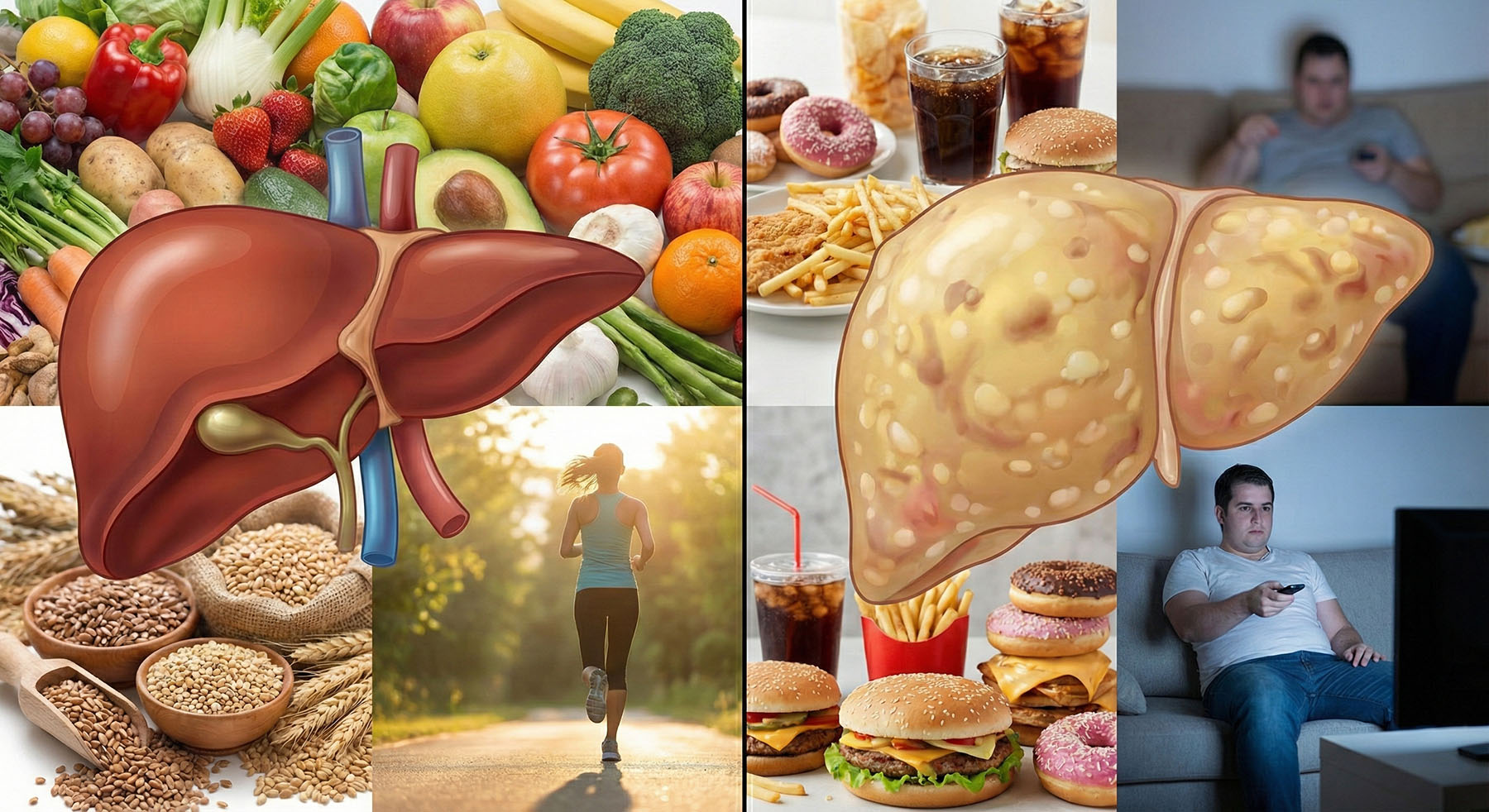
The condition formerly known as Non-Alcoholic Fatty Liver Disease (NAFLD) has been officially renamed Metabolic Dysfunction-Associated Steatotic Liver Disease (MASLD). This change, driven by a global multi-society Delphi consensus, was made to remove the stigma associated with the term “fatty” and to more accurately reflect the disease’s root cause: metabolic dysfunction rather than simply the absence of alcohol use (Rinella et al., 2023). The condition has become a silent epidemic, affecting approximately 30% to 38% of the global adult population, meaning the estimate of “1 in 4” adults is now considered conservative (Younossi et al., 2024). Unlike alcohol-associated liver disease, MASLD is defined by the presence of hepatic steatosis (liver fat) in conjunction with cardiometabolic risk factors such as obesity, type 2 diabetes, or hypertension.
The Sugar Trap: How Fructose Drives Liver Fat
Contrary to popular belief, dietary fat is not the sole driver of a “fatty liver.” Emerging research highlights that excess sugar—specifically fructose—is a more potent inducer of hepatic fat accumulation than glucose. Unlike glucose, which is widely utilized by cells for energy or stored as glycogen, fructose is primarily metabolized in the liver, where it preferentially fuels de novo lipogenesis (the creation of new fat) (Geidl-Flueck & Gerber, 2023). This process contributes directly to visceral adiposity and insulin resistance, the hallmark metabolic defects of MASLD. When insulin resistance occurs, the body acts as if it is in a constant state of nutrient excess, signaling the liver to store even more energy as visceral fat, creating a vicious cycle of metabolic dysfunction (Sandireddy et al., 2024).
Reversing the Damage: The Power of Regeneration and Resistance
The most encouraging aspect of MASLD is the liver’s extraordinary capacity for regeneration. Interventions that target the root metabolic cause can reverse fat accumulation effectively. While general weight loss is beneficial, resistance training has been identified as a uniquely powerful tool. Clinical trials have demonstrated that resistance exercise can significantly reduce liver fat content and improve insulin sensitivity even in the absence of weight loss (Hallsworth et al., 2011; Medeiros et al., 2024). By increasing muscle mass, you create a “glucose sink” that relieves metabolic pressure on the liver. Combining strength training with the elimination of liquid fructose (such as sodas and juices) offers a robust, evidence-based strategy to reverse early-stage MASLD and restore metabolic health (Mambrini et al., 2024).
References
- Geidl-Flueck, B., & Gerber, P. A. (2023). Fructose drives de novo lipogenesis affecting metabolic health. Journal of Endocrinology, 257(2). https://doi.org/10.1530/joe-22-0270
- Hallsworth, K., Fattakhova, G., Hollingsworth, K. G., Thoma, C., Moore, S., Taylor, R., Day, C. P., & Trenell, M. I. (2011). Resistance exercise reduces liver fat and its mediators in non-alcoholic fatty liver disease independent of weight loss. Gut, 60(9), 1278–1283. https://doi.org/10.1136/gut.2011.242073
- Mambrini, S. P., Grillo, A., Colosimo, S., Zarpellon, F., Pozzi, G., Furlan, D., Amodeo, G., & Bertoli, S. (2024). Diet and physical exercise as key players to tackle MASLD through improvement of insulin resistance and metabolic flexibility. Frontiers in Nutrition, 11. https://doi.org/10.3389/fnut.2024.1426551
- Medeiros, D. G., Ferreira, L. F., Lamp, J. d. S., & Telles da Rosa, L. H. (2024). The impact of resistance training in patients diagnosed with metabolic dysfunction-associated steatotic liver disease: a systematic review. European Journal of Gastroenterology & Hepatology, 37(2), 129–136. https://doi.org/10.1097/meg.0000000000002887
- Rinella, M. E., Lazarus, J. V., Ratziu, V., Francque, S. M., Sanyal, A. J., Kanwal, F., et al. (2023). A multisociety Delphi consensus statement on new fatty liver disease nomenclature. Journal of Hepatology, 79(6), 1542–1556. https://doi.org/10.1016/j.jhep.2023.06.003
- Sandireddy, R., Sakthivel, S., Gupta, P., Behari, J., Tripathi, M., & Singh, B. K. (2024). Systemic impacts of metabolic dysfunction-associated steatotic liver disease (MASLD) and metabolic dysfunction-associated steatohepatitis (MASH) on heart, muscle, and kidney related diseases. Frontiers in Cell and Developmental Biology, 12. https://doi.org/10.3389/fcell.2024.1433857
- Younossi, Z. M., Kalligeros, M., & Henry, L. (2024). Epidemiology of metabolic dysfunction-associated steatotic liver disease. Clinical and Molecular Hepatology. https://doi.org/10.3350/cmh.2024.0431
Comments are closed