
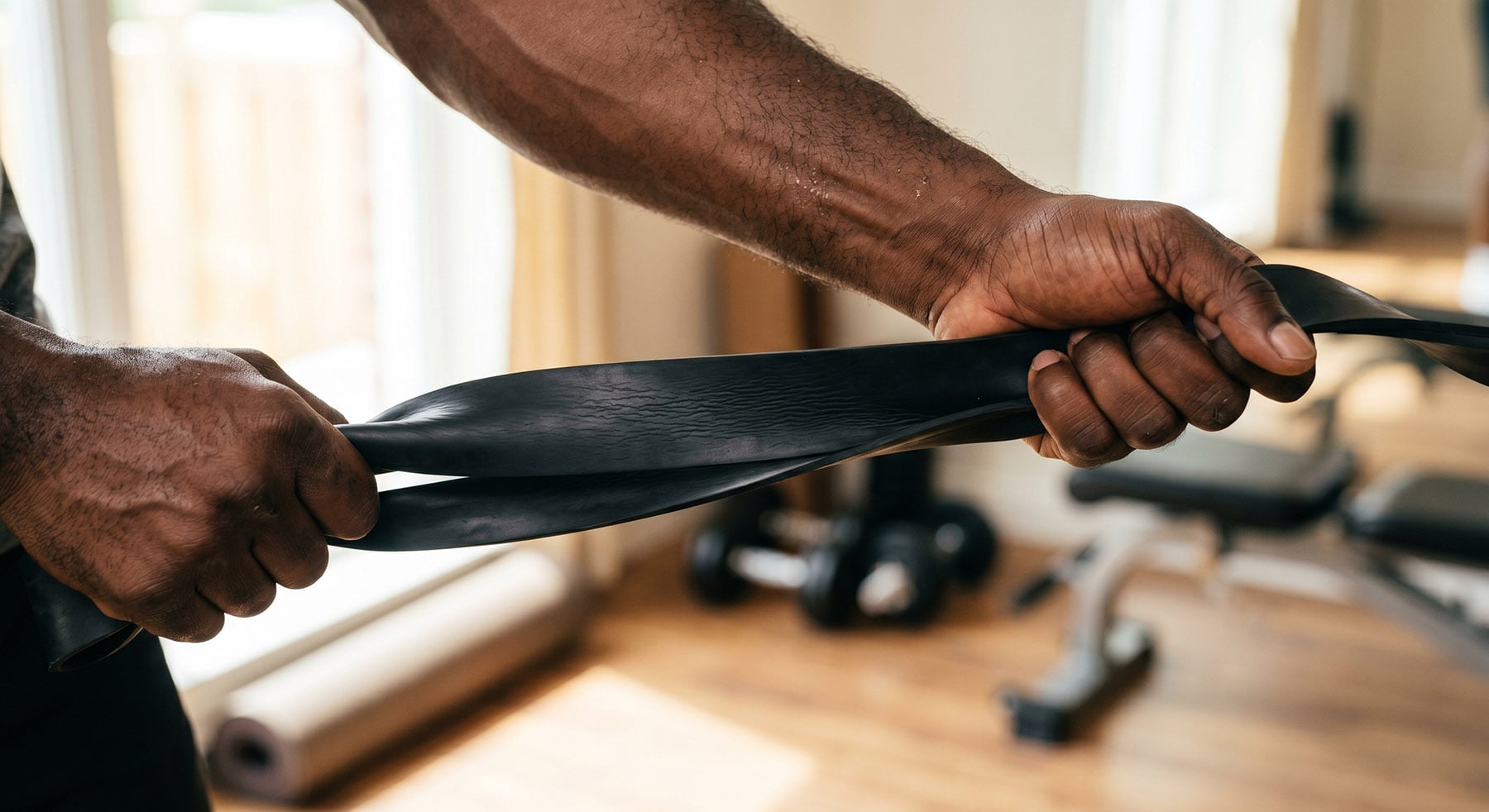
Walk into any commercial gym and you will see people chasing heavier and heavier loads, convinced that iron is the only path to muscle. The physiology tells a more nuanced story. Muscle growth is driven by mechanical tension and time under load, not by the numerical weight on the bar. Elastic resistance bands generate force through a different curve than free weights: tension rises as the band stretches, meaning the load is lightest at the start of a lift and heaviest at the peak of contraction. This matches the strength curve of most muscles, which are mechanically strongest in the middle of their range. The result is a recruitment pattern that keeps high-threshold motor units engaged through the full movement rather than only at the hardest mechanical position.
For adults over fifty, or anyone with aging joints, bands offer a second advantage that iron simply cannot match. Free weights deliver constant gravitational load at every angle, which places enormous shear stress on the elbows, knees, and spine at the transition points of each lift. Bands taper that load at exactly those moments of joint vulnerability. The accumulated training volume a sixty-year-old can tolerate with bands is often substantially higher than with barbells, and systematic reviews have shown comparable gains in strength, hypertrophy, and functional capacity when the two modalities are matched for intensity. Bands also engage stabilizers aggressively, because the three-dimensional instability of an elastic line forces the nervous system to continuously correct for micro-shifts in the load.
Practical programming is simple. Most bands include a color-coded tension equivalent, and a single multi-band set costs less than two months of a gym membership. A full-body routine of three sets of twelve band squats, banded rows, standing presses, hip abductions, and pallof presses delivers the same longevity dividend as a conventional resistance program. Anchor the band around a sturdy post, a doorframe anchor, or your own foot, and you have a traveling gym that fits in a backpack. For rehabilitation, post-surgical recovery, or simply preserving the capacity to lift a grandchild or a suitcase decades from now, bands may quietly be the single most durable investment in functional longevity you can make.
References:
- Lopes, J. S. S., Machado, A. F., Micheletti, J. K., de Almeida, A. C., Cavina, A. P., & Pastre, C. M. (2019). Effects of training with elastic resistance versus conventional resistance on muscular strength: A systematic review and meta-analysis. SAGE Open Medicine, 7, 2050312119831116.
- Colado, J. C., & Triplett, N. T. (2008). Effects of a short-term resistance program using elastic bands versus weight machines for sedentary middle-aged women. Journal of Strength and Conditioning Research, 22(5), 1441-1448.
- Suchomel, T. J., Nimphius, S., Bellon, C. R., & Stone, M. H. (2018). The importance of muscular strength: Training considerations. Sports Medicine, 48(4), 765-785.
Comments are closed