
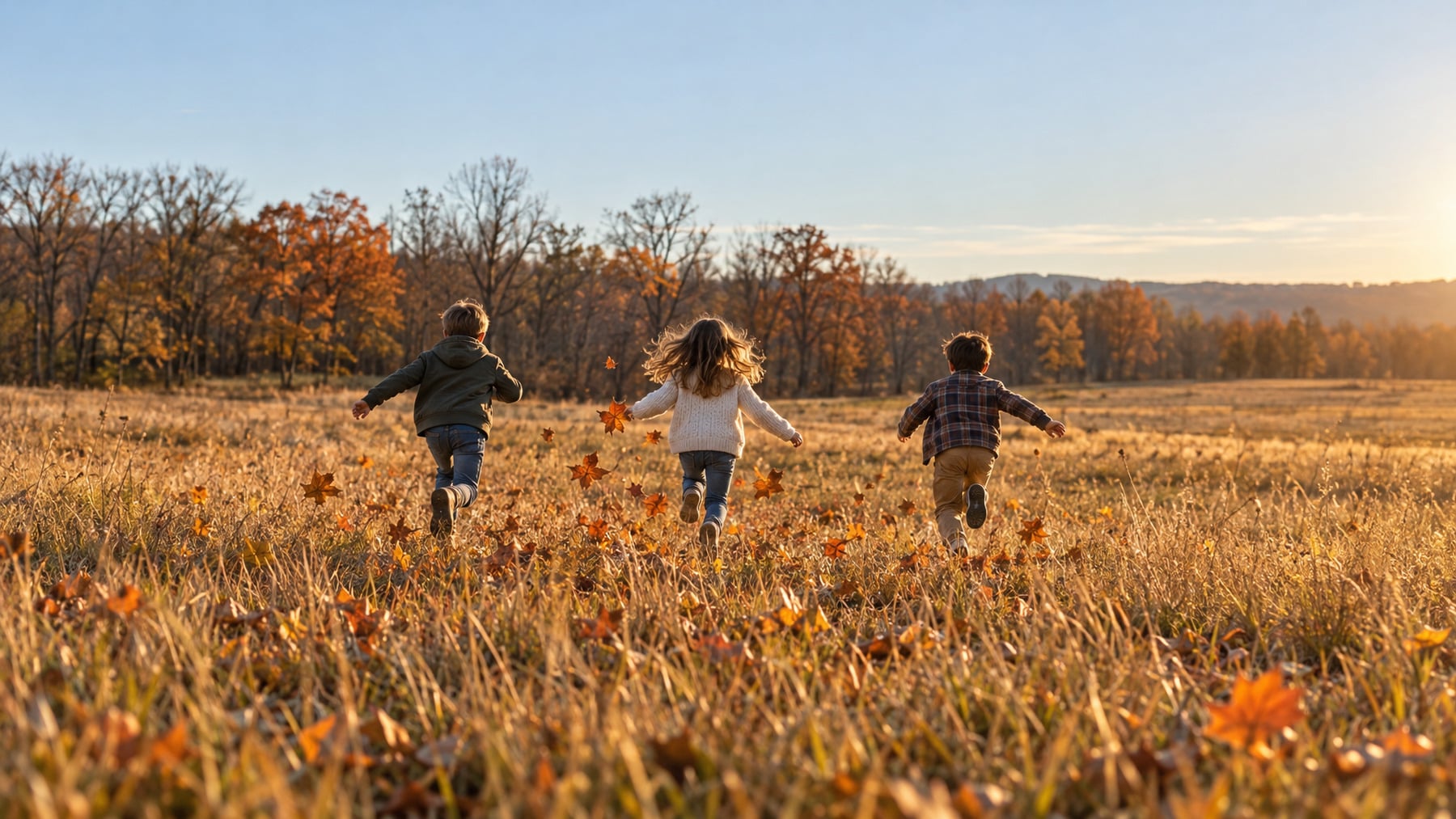
- In a randomized trial of about 1,900 first graders, adding one 40-minute outdoor class to each school day lowered the three-year rate of new nearsightedness from 39.5% to 30.4%.
- Measured at a child’s eye height, outdoor light reached 11,080 to 18,176 lux versus 112 to 156 lux indoors, and even tree shade reached 5,556 to 7,876 lux, well above the roughly 1,000 lux linked to protection.
- Pooled studies show more time outdoors lowers the chance of becoming nearsighted, but the evidence that it slows nearsightedness that has already started is mixed.
Every parent has heard it: screens are ruining kids’ eyes. It is an easy villain, and screen time may play some part. But the bigger factor may be simpler and easier to fix: how little daylight children actually see. Now that the clocks have fallen back and afternoons go dark early, a lot of kids go from a classroom to a car to a living room without spending real time outside at all. That matters, because nearsightedness, where distance looks blurry and glasses are needed to see the board, is mostly a problem of the eyeball growing too long during childhood, and time outdoors is one of the few things shown in randomized trials to make that less likely. If you are trying to prevent nearsightedness in kids, the most useful question is not only “how much screen time?” It is “how many hours a day are they outside?” This is a different issue from a lazy eye, where one eye falls behind. Nearsightedness usually affects both eyes, and it tends to show up and worsen through the school years, which is exactly when daily habits can still shape it.
The difference between indoors and outdoors is far bigger than our eyes let on. In one study, a light meter mounted on a child-sized model head read 112 to 156 lux under typical indoor lighting and 11,080 to 18,176 lux outdoors. Even under a tree, it read 5,556 to 7,876 lux, and a hat still left more than 4,000. Researchers link protection to roughly 1,000 lux or more, a level ordinary indoor light rarely reaches. The trials back this up. In a school trial of about 1,900 first graders, one extra 40-minute outdoor class a day lowered the three-year rate of new nearsightedness from 39.5% to 30.4%. In another school trial, encouraging children to spend up to 11 hours a week outside cut the odds of rapid progression by more than half, and the authors noted that strong sunlight may not be necessary: longer time in lower outdoor light, such as under trees, also helped. As for screens, a 2021 meta-analysis did find smart-device use linked with nearsightedness, but the studies relied on questionnaires for screen time and were inconsistent. The daylight evidence includes randomized trials; the screen evidence mostly does not.
How much outdoor time does it take to prevent nearsightedness in kids?
The best data point to about two hours a day. In a large Shanghai school trial, 120 to 150 minutes outdoors daily, at around 5,000 lux, reduced new nearsightedness by roughly 15% to 24%. I’m less worried about the tablet than about the kid who never goes outside. So I would not spend all of your energy policing screens and none on getting kids outdoors. Practical moves: protect recess, walk or bike part of the way to school if it is safe, push homework a little later so there is daylight time after school, and make weekends count now that weekday afternoons are shorter. Shade, hats, and sunglasses still leave far more light than any classroom, so sun protection and outdoor time are not in conflict. One honest limit: in pooled studies, more time outdoors clearly lowered the chance of becoming nearsighted, but its effect on slowing nearsightedness that has already started is less certain. If your child already wears glasses for distance and their prescription keeps climbing, ask their eye doctor about other ways to slow it. Daylight is the cheapest eye protection your kids will ever get.
References
- He, M., Xiang, F., Zeng, Y., Mai, J., Chen, Q., Zhang, J., et al. (2015). Effect of time spent outdoors at school on the development of myopia among children in China: A randomized clinical trial. JAMA, 314(11), 1142-1148.
- Lanca, C., Teo, A., Vivagandan, A., Htoon, H. M., Najjar, R. P., Spiegel, D. P., et al. (2019). The effects of different outdoor environments, sunglasses and hats on light levels: Implications for myopia prevention. Translational Vision Science & Technology, 8(4), 7.
- Wu, P. C., Chen, C. T., Lin, K. K., Sun, C. C., Kuo, C. N., Huang, H. M., et al. (2018). Myopia prevention and outdoor light intensity in a school-based cluster randomized trial. Ophthalmology, 125(8), 1239-1250.
- He, X., Sankaridurg, P., Wang, J., Chen, J., Naduvilath, T., He, M., et al. (2022). Time outdoors in reducing myopia: A school-based cluster randomized trial with objective monitoring of outdoor time and light intensity. Ophthalmology, 129(11), 1245-1254.
- Xiong, S., Sankaridurg, P., Naduvilath, T., Zang, J., Zou, H., Zhu, J., et al. (2017). Time spent in outdoor activities in relation to myopia prevention and control: A meta-analysis and systematic review. Acta Ophthalmologica, 95(6), 551-566.
- Foreman, J., Salim, A. T., Praveen, A., Fonseka, D., Ting, D. S. W., He, M. G., et al. (2021). Association between digital smart device use and myopia: A systematic review and meta-analysis. The Lancet Digital Health, 3(12), e806-e818.
Comments are closed