Key Takeaways
- A systematic review of 15 studies found that slow breathing, under 10 breaths a minute, raises heart rate variability, a marker of the body’s calming nervous system, and is linked to more relaxation and less anxiety.
- In an 8-week randomized study of 40 healthy adults, diaphragmatic breathing training at about 4 breaths a minute lowered salivary cortisol and negative mood and improved sustained attention.
- In severe COPD, diaphragmatic breathing can backfire: in a small study it made chest and belly movement less coordinated and breathing less efficient, and breathlessness tended to increase.
Try this before you read any further. Put one hand on your chest, one on your belly, and take an ordinary breath. If the top hand moves first and your shoulders creep up toward your ears, you may be doing what a lot of busy, stressed adults do all day: leaning on the muscles of the neck and upper chest more than the diaphragm, the dome-shaped muscle under your ribs that is built to do most of the work. Most people think breathing exercises are about counting, four in, hold for seven, a box of four by four, and that the right numbers unlock the calm. Counting can help you slow down, but I think it misses the more basic question of where the breath is going. Belly breathing simply means letting the diaphragm lead: as it pulls down on the inhale, your belly moves out, and your shoulders barely move at all. When the breath sits high in the chest, it tends to be quick and shallow, and quick breathing tends to travel with feeling on edge, though which comes first isn’t settled. Slow it down and move it lower, and you are pushing the other way.
The evidence for slow breathing is better than you might expect, though the studies are small. A systematic review of 15 studies found that breathing under 10 times a minute increases heart rate variability, a measure of how active the body’s calming branch of the nervous system is, alongside more relaxation and less anxiety, anger and confusion. In an 8-week randomized study of 40 healthy adults trained in diaphragmatic breathing at about 4 breaths a minute, salivary cortisol and negative mood fell and sustained attention improved, while the untrained group did not change. A review of diaphragmatic breathing studies found all three that qualified reported lower stress, measured by cortisol, blood pressure or questionnaires. Then came a surprising detail: in a month-long randomized study, five minutes a day of cyclic sighing, which emphasizes a long, slow exhale, improved mood and slowed resting breathing more than the same five minutes of mindfulness meditation. With COPD, the picture changes. A Cochrane review found breathing exercises improved walking distance but had no consistent effect on breathlessness, and in severe disease diaphragmatic breathing made chest and belly movement less coordinated and breathing less efficient.
Is belly breathing actually better than chest breathing?
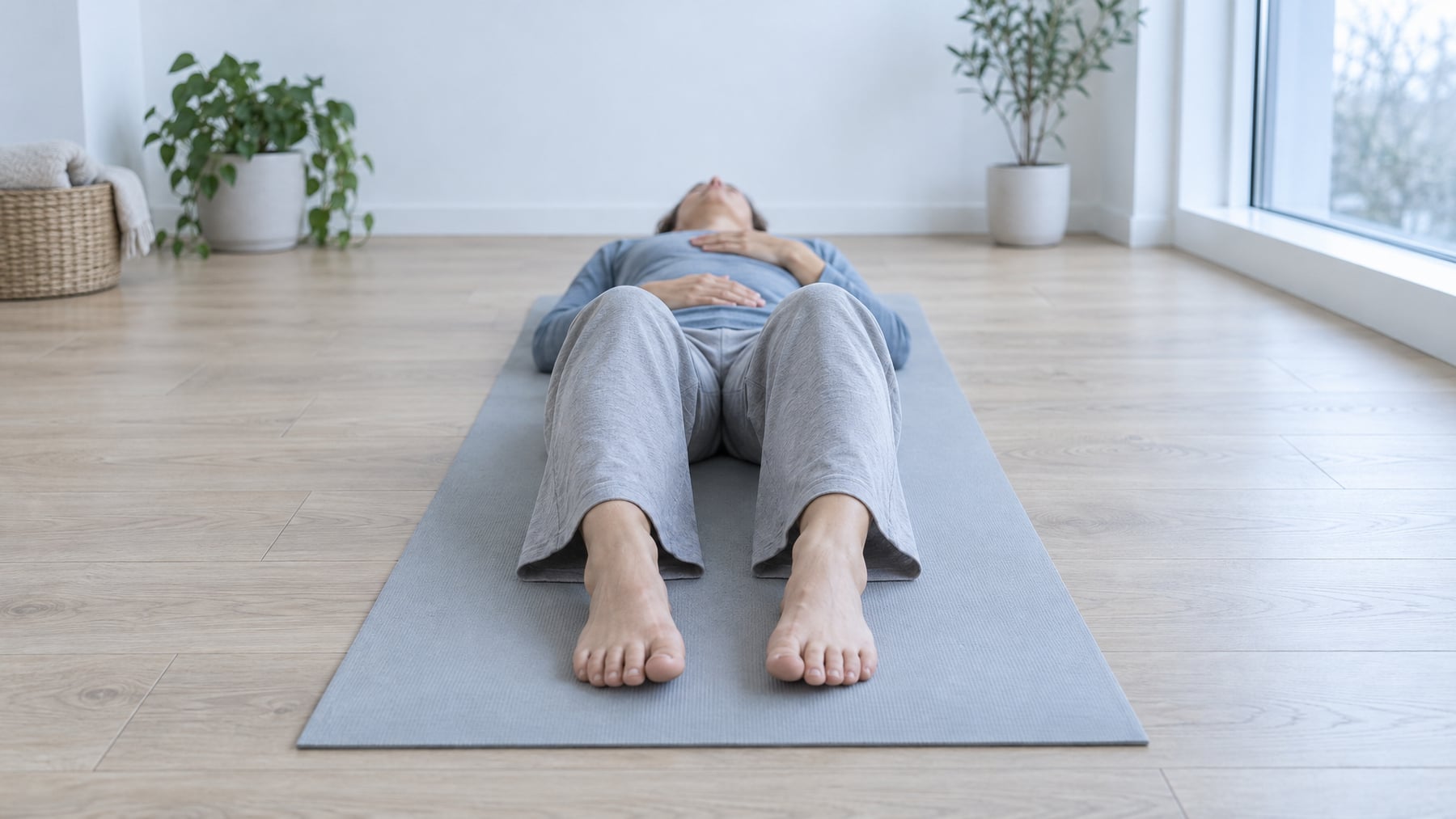
For most people under stress, it’s the easier road to what matters most, a slower breath. Most breathing apps teach counting. I care more about how slowly you breathe and how long you take to let it out, and letting the belly lead is the simplest way I know to get there. Here is a simple way to practice. Lie on your back with your knees bent, one hand on your belly and one on your chest. Breathe in gently through your nose and let the belly hand rise while the chest hand stays almost still. Then let the air out slowly through your nose or softly pursed lips, making the exhale longer than the inhale. Aim for a pace that feels unhurried, well under 10 breaths a minute, for about five minutes, once or twice a day. Once it feels natural lying down, try it sitting at your desk or in the car. If you live with COPD or another lung condition, do not force deep belly breaths on your own, because in severe disease it can make breathing harder; ask your lung team or a pulmonary rehabilitation program which technique fits your lungs, since pursed-lip breathing is often the better starting point. And if breathlessness is new or getting worse, that is a reason to be seen, not a reason to practice harder. Your shoulders are a stress gauge. Check them at the next red light.
References
- Zaccaro, A., Piarulli, A., Laurino, M., Garbella, E., Menicucci, D., Neri, B., et al. (2018). How breath-control can change your life: A systematic review on psycho-physiological correlates of slow breathing. Frontiers in Human Neuroscience, 12, 353.
- Ma, X., Yue, Z. Q., Gong, Z. Q., Zhang, H., Duan, N. Y., Shi, Y. T., et al. (2017). The effect of diaphragmatic breathing on attention, negative affect and stress in healthy adults. Frontiers in Psychology, 8, 874.
- Hopper, S. I., Murray, S. L., Ferrara, L. R., & Singleton, J. K. (2019). Effectiveness of diaphragmatic breathing for reducing physiological and psychological stress in adults: A quantitative systematic review. JBI Database of Systematic Reviews and Implementation Reports, 17(9), 1855-1876.
- Balban, M. Y., Neri, E., Kogon, M. M., Weed, L., Nouriani, B., Jo, B., et al. (2023). Brief structured respiration practices enhance mood and reduce physiological arousal. Cell Reports Medicine, 4(1), 100895.
- Holland, A. E., Hill, C. J., Jones, A. Y., & McDonald, C. F. (2012). Breathing exercises for chronic obstructive pulmonary disease. Cochrane Database of Systematic Reviews, 10, CD008250.
- Gosselink, R. A., Wagenaar, R. C., Rijswijk, H., Sargeant, A. J., & Decramer, M. L. (1995). Diaphragmatic breathing reduces efficiency of breathing in patients with chronic obstructive pulmonary disease. American Journal of Respiratory and Critical Care Medicine, 151(4), 1136-1142.
Comments are closed