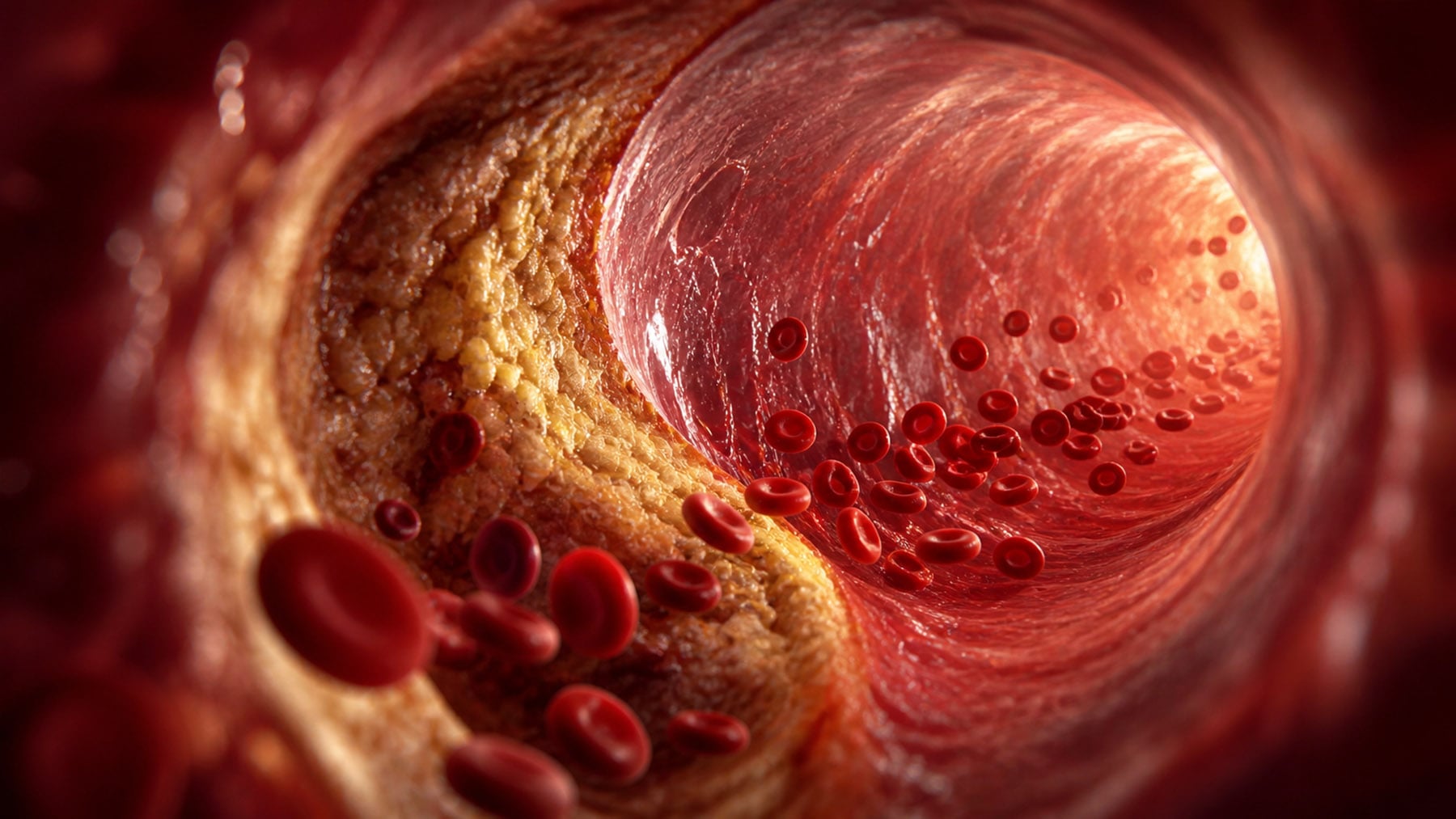
For decades, coronary plaque was framed as a progressive accumulation, with treatment aimed at slowing rather than reversing the process. That framing has shifted with two decades of intravascular ultrasound and serial computed tomography studies. Aggressive low-density lipoprotein lowering, particularly when LDL cholesterol drops below seventy and ideally below fifty-five milligrams per deciliter, consistently demonstrates measurable reduction in atheroma volume. The ASTEROID, SATURN, and GLAGOV trials, using high-intensity statin therapy and the PCSK9 inhibitor evolocumab respectively, each documented millimeters of plaque regression on intravascular ultrasound when LDL was driven aggressively low for eighteen to twenty-four months. The plaque is not static; it is a dynamic deposit whose direction depends on the surrounding biochemical environment.
The biology underlying regression is more interesting than the topline numbers. The lipid core of an atherosclerotic plaque is largely composed of oxidized LDL particles and cholesteryl esters trapped within macrophage-derived foam cells. When circulating LDL falls and apolipoprotein A-I and HDL particles increase, the gradient reverses. Reverse cholesterol transport—the efflux of cholesterol from foam cells back to the liver via scavenger receptor B1 and the ABCA1 and G1 transporters—accelerates. Simultaneously, declining oxidized LDL exposure quiets the endothelial NF-kappa-B inflammatory program, the fibrous cap thickens with smooth muscle cells and collagen, and the lesion remodels from a vulnerable thin-capped fibroatheroma into a stable, calcified, less rupture-prone plaque. The arterial wall, in short, is alive and continuously renegotiates its own composition.
The clinical translation is that lifestyle and pharmacologic levers act on the same biology and that their effects compound. The Ornish, Esselstyn, and Pritikin programs each demonstrated angiographic regression in highly motivated patients using whole-food plant-based diets, daily exercise, stress management, and smoking cessation. The lifestyle effect is amplified, not replaced, by appropriate use of statins, ezetimibe, bempedoic acid, and PCSK9 inhibitors when targets are not reached with diet alone. ApoB and lipoprotein(a) measurement now allow much more precise risk stratification than total cholesterol, and patients with strong family histories or elevated coronary artery calcium scores deserve the lower target. The point is not that the plaque vanishes overnight, but that the trajectory is genuinely reversible when the underlying drivers are addressed seriously.
References:
- Nissen, S. E., Nicholls, S. J., Sipahi, I., Libby, P., Raichlen, J. S., Ballantyne, C. M., et al. (2006). Effect of very high-intensity statin therapy on regression of coronary atherosclerosis: The ASTEROID trial. JAMA, 295(13), 1556-1565.
- Nicholls, S. J., Puri, R., Anderson, T., Ballantyne, C. M., Cho, L., Kastelein, J. J. P., et al. (2016). Effect of evolocumab on progression of coronary disease in statin-treated patients: The GLAGOV randomized clinical trial. JAMA, 316(22), 2373-2384.
- Ornish, D., Scherwitz, L. W., Billings, J. H., Brown, S. E., Gould, K. L., Merritt, T. A., et al. (1998). Intensive lifestyle changes for reversal of coronary heart disease. JAMA, 280(23), 2001-2007.
Comments are closed