
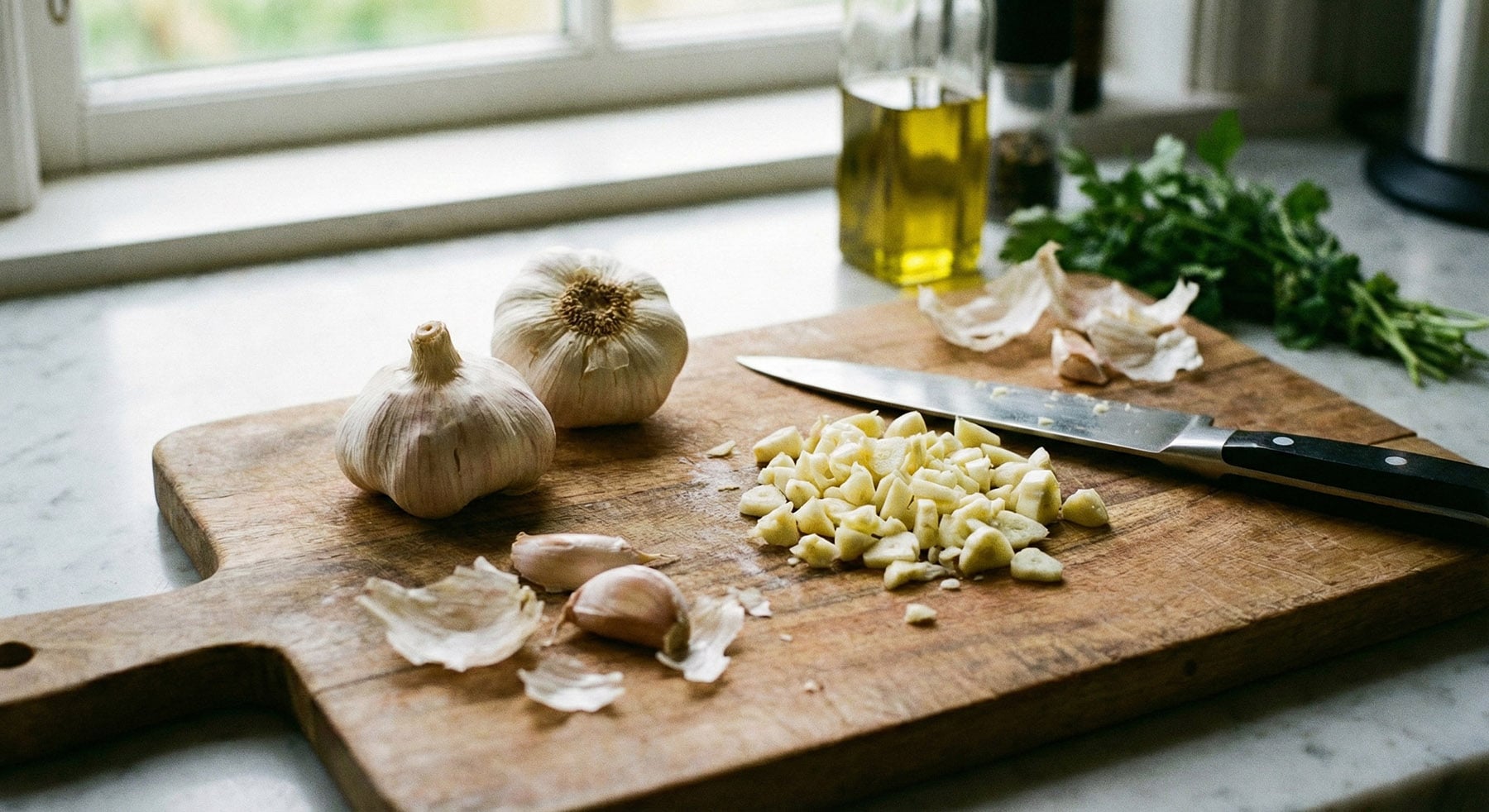
Garlic is often celebrated for its bold flavor, but its true power lies in a potent sulfur compound called allicin, which serves as the plant’s defense mechanism against pests. Allicin is not present in whole garlic cloves; it is only created when the clove is mechanically damaged—crushed, chopped, or chewed. This action ruptures the cell walls, allowing the amino acid alliin to mix with the enzyme alliinase. This biochemical reaction produces allicin, the compound responsible for garlic’s signature pungent aroma and its profound medicinal properties. However, this reaction is not instant; it requires a brief window of time to reach its full potential, a nuance often overlooked in modern, fast-paced cooking.
From a cardiovascular perspective, allicin is a powerhouse supporting arterial health. Research indicates that allicin facilitates vasorelaxation, the widening of blood vessels, which improves blood flow and reduces blood pressure. It achieves this partially by stimulating the production of nitric oxide in the endothelium (the inner lining of blood vessels) and by modulating ion channels in vascular smooth muscle. Furthermore, in the Breithaupt-Grögler 1997 observational study, adults who had taken at least 300 mg per day of standardized garlic powder for two or more years showed pulse wave velocity of 8.3 m/s versus 9.8 m/s in matched controls, demonstrating measurable attenuation of age-related aortic stiffening. By maintaining the elasticity of the aorta and other major arteries, garlic helps reduce the workload on the heart and lowers the risk of cardiovascular events associated with arterial hardening.
To maximize these benefits, the “press and rest” method is essential. The enzyme alliinase, which is required to produce allicin, is extremely heat-sensitive and is rapidly inactivated by cooking temperatures. If you chop garlic and immediately throw it into a hot pan, the enzyme is destroyed before it can convert the alliin into allicin, significantly reducing the medicinal value of the dish. By chopping the garlic and letting it rest for 10 minutes away from heat, you allow the enzymatic reaction to complete, generating the maximum amount of allicin. Once created, allicin is reasonably stable and can better withstand short cooking times, ensuring you get the heart-healthy benefits alongside the flavor.
References:
- Breithaupt-Grögler, K., Ling, M., Boudoulas, H., & Belz, G. G. (1997). Protective effect of chronic garlic intake on elastic properties of aorta in the elderly. Circulation, 96(8), 2649-2655.
- Sun, X., & Ku, D. D. (2006). Allicin in garlic protects against coronary endothelial dysfunction and right heart hypertrophy in pulmonary hypertensive rats. American Journal of Physiology – Heart and Circulatory Physiology, 291(5), H2431-H2438.
- Lawson, L. D., & Wang, Z. J. (2001). Low allicin release from garlic supplements: A major problem due to the sensitivities of alliinase activity. Journal of Agricultural and Food Chemistry, 49(5), 2592-2599.
Comments are closed