Key Takeaways:
- Genistein, the main isoflavone in soy, competes more strongly for estrogen receptor beta than for estrogen receptor alpha, and in breast cancer cells receptor beta opposes the growth signal that receptor alpha delivers.
- In the Shanghai Breast Cancer Survival Study of 5,042 survivors, women in the highest quartile of soy protein intake had a 29 percent lower risk of death and a 32 percent lower risk of recurrence than women in the lowest quartile, in both estrogen receptor-positive and -negative disease and in tamoxifen users and nonusers alike.
- A pooled analysis of 9,514 breast cancer survivors in the United States and China found that eating at least 10 milligrams of isoflavones a day from soy foods was associated with a 25 percent lower risk of recurrence.
Breast Cancer Awareness Month brings one food question back every year, usually from someone who has just finished treatment and has quietly stopped eating tofu. The worry about soy and breast cancer is understandable on its face. Soy isoflavones such as genistein are phytoestrogens, plant compounds shaped enough like estradiol to fit into an estrogen receptor, and most breast cancers are fueled by estrogen. But “estrogen receptor” is really two receptors with different jobs. Estrogen receptor alpha is the one that drives proliferation in breast tissue, the target of tamoxifen and aromatase inhibitors. Estrogen receptor beta behaves more like a counterweight. When researchers introduced receptor beta into receptor alpha-positive breast cancer cells, estradiol stopped making them grow: the cells repressed the growth genes c-myc and cyclin D1, raised the cell-cycle brakes p21 and p27, stalled in the G2 phase, and failed to form tumors in mice. Genistein, in turn, competes more strongly for binding to receptor beta than to receptor alpha. It still activates both, so it is a weak estrogen rather than an anti-estrogen, which is exactly why the question could only be settled by following real women over time.
That is what the Shanghai Breast Cancer Survival Study did. It enrolled 5,042 women after a breast cancer diagnosis, measured soy food intake repeatedly at six, 18, 36, and 60 months, verified treatment from medical charts, and followed them for a median of almost four years. Women in the highest quartile of soy protein intake had a 29 percent lower risk of death and a 32 percent lower risk of recurrence than those in the lowest quartile. The adjusted four-year recurrence rate was 8.0 percent in the highest quartile versus 11.2 percent in the lowest. The association held in estrogen receptor-positive and estrogen receptor-negative disease, and in women taking tamoxifen as well as those who were not, which directly addresses the fear that soy might blunt the drug. The After Breast Cancer Pooling Project then combined 9,514 survivors from two American cohorts and one Chinese cohort, followed for an average of 7.4 years. Despite enormous differences in how much soy the two countries eat, intake of 10 milligrams of isoflavones a day or more was associated with a 25 percent lower risk of recurrence, with no heterogeneity between countries.
Is soy safe after breast cancer?
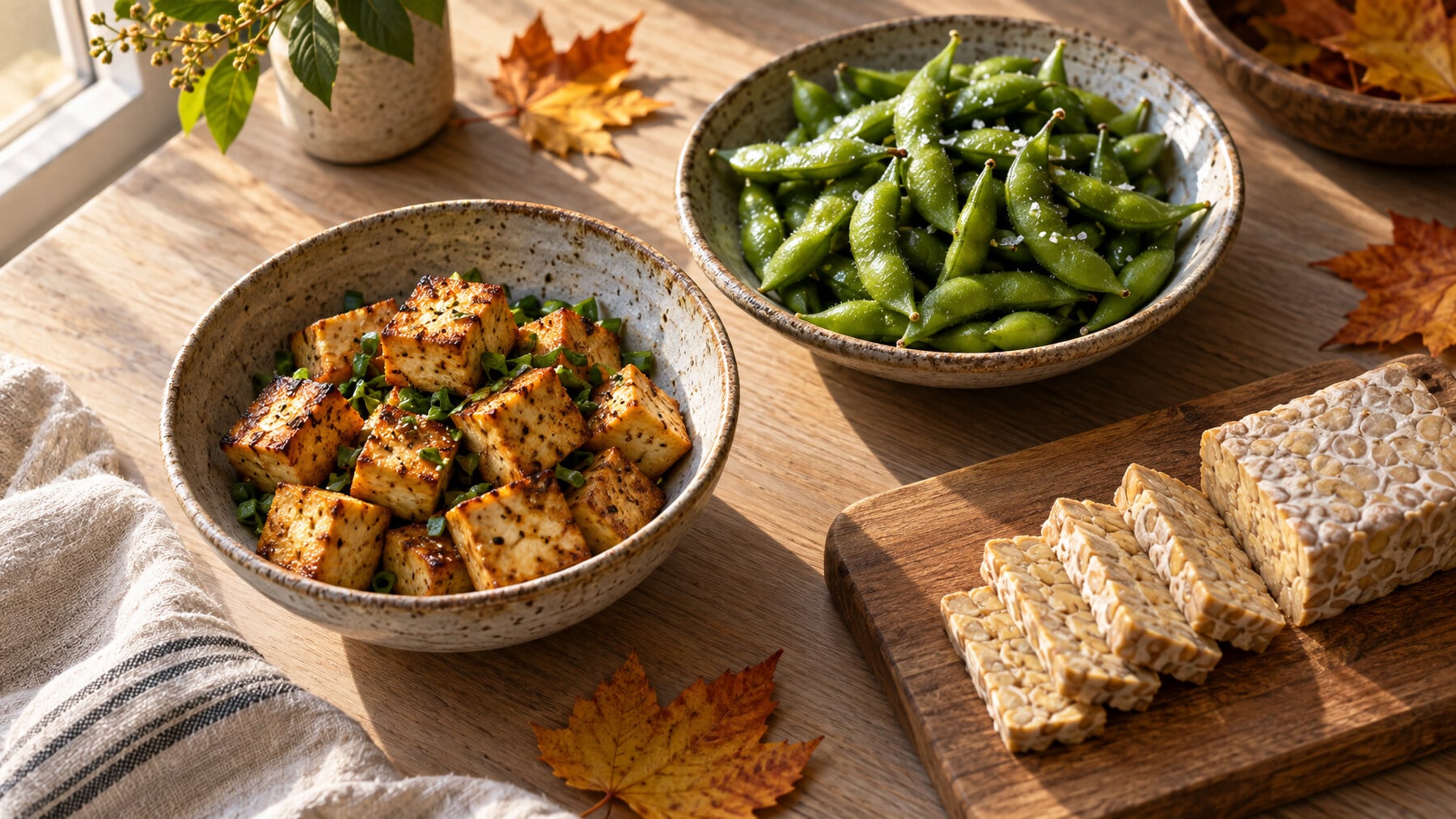
On the evidence available, soy foods are safe after breast cancer, and the direction of every large survivor cohort points toward benefit rather than harm. The honest caveats are worth stating plainly. These are observational studies, so women who eat more soy may differ in other ways that no statistical adjustment fully captures. In the pooled analysis, the lower risks of death from any cause and from breast cancer did not reach statistical significance; only the reduction in recurrence did. A 2019 meta-analysis of 12 studies reached a similar picture: soy eaten after diagnosis was linked to less recurrence, while its association with overall survival was not statistically significant. And every one of these studies measured food, not pills. Concentrated isoflavone supplements deliver doses in isolation and on a schedule that no cohort has tested, so the reassurance does not transfer to them. The practical translation is simple. Tofu, edamame, tempeh, miso, and unsweetened soy milk can stay on the plate, in the everyday amounts people actually eat, as a replacement for processed or red meat rather than an addition to it. What soy should never become is a substitute for prescribed endocrine therapy, which remains the treatment with proven survival benefit.
References:
- Kuiper, G. G., Lemmen, J. G., Carlsson, B., Corton, J. C., Safe, S. H., van der Saag, P. T., et al. (1998). Interaction of estrogenic chemicals and phytoestrogens with estrogen receptor beta. Endocrinology, 139(10), 4252-4263.
- Paruthiyil, S., Parmar, H., Kerekatte, V., Cunha, G. R., Firestone, G. L., & Leitman, D. C. (2004). Estrogen receptor beta inhibits human breast cancer cell proliferation and tumor formation by causing a G2 cell cycle arrest. Cancer Research, 64(1), 423-428.
- Shu, X. O., Zheng, Y., Cai, H., Gu, K., Chen, Z., Zheng, W., et al. (2009). Soy food intake and breast cancer survival. JAMA, 302(22), 2437-2443.
- Nechuta, S. J., Caan, B. J., Chen, W. Y., Lu, W., Chen, Z., Kwan, M. L., et al. (2012). Soy food intake after diagnosis of breast cancer and survival: an in-depth analysis of combined evidence from cohort studies of US and Chinese women. The American Journal of Clinical Nutrition, 96(1), 123-132.
- Qiu, S., & Jiang, C. (2019). Soy and isoflavones consumption and breast cancer survival and recurrence: a systematic review and meta-analysis. European Journal of Nutrition, 58(8), 3079-3090.
Comments are closed