
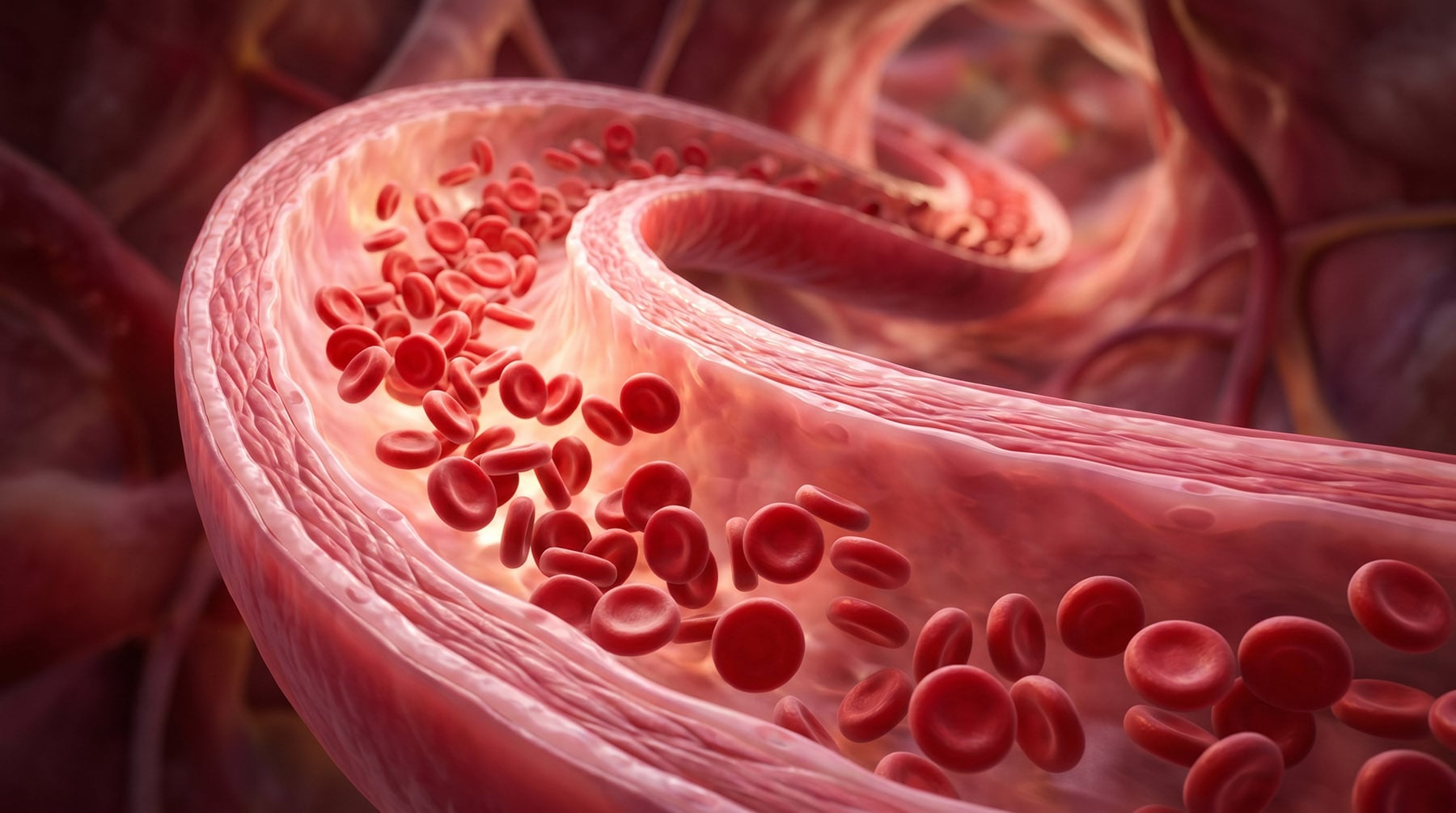
The endothelium, the single-cell-thick lining of every blood vessel in the body, is not a smooth, sterile pipe. It is coated with a delicate, hair-like layer of glycoproteins, glycosaminoglycans, and proteoglycans called the glycocalyx, two-tenths to one micron thick depending on the vessel. Despite contributing nearly a liter of plasma volume in total when summed across the entire vasculature, this structure was largely invisible to twentieth-century imaging and remained a footnote until intravital microscopy and side-stream dark-field videomicroscopy in the 2000s allowed direct visualization. The glycocalyx is now recognized as a primary mechanical and signaling interface between blood and vessel wall—it transduces shear stress into endothelial nitric oxide release, regulates leukocyte adhesion, and excludes plasma proteins from contact with the underlying cell surface.
The functional importance of this layer becomes clearest when it is damaged. Hyperglycemia, oxidized LDL, sustained high sodium intake, sepsis, and ischemia-reperfusion all measurably shed glycocalyx components into the circulation; serum syndecan-1 and heparan sulfate fragments are now used as biomarkers of degradation in critical care settings. With the protective layer thinned, LDL particles gain direct access to subendothelial space, leukocyte rolling and adhesion accelerate, capillary permeability rises, and the endothelium loses its ability to translate shear stress into vasodilatory signaling. The early stages of atherosclerosis, diabetic microvascular disease, hypertensive end-organ damage, and the capillary leak of severe sepsis all share glycocalyx injury as a common upstream lesion.
The clinical translation is that the levers patients hear about for vascular health—glucose control, dietary moderation of sodium and refined carbohydrates, avoidance of tobacco, and regular exercise—protect the glycocalyx specifically. Postprandial glucose excursions above one hundred eighty milligrams per deciliter measurably degrade the layer within hours, recovering only over days. Dietary nitrate from leafy greens and beets, sulfated polysaccharides from whole foods, and adequate hydration support synthesis. Several investigational therapies, including sulodexide, are in trials for diabetic nephropathy with glycocalyx restoration as the proposed mechanism. For now, the actionable message is that the smoothness and youthful behavior of the arteries depends on a structure most patients have never heard of, and the same lifestyle choices that lower cholesterol and blood pressure are the ones that keep this hidden lining intact.
References:
- Reitsma, S., Slaaf, D. W., Vink, H., van Zandvoort, M. A. M. J., & oude Egbrink, M. G. A. (2007). The endothelial glycocalyx: Composition, functions, and visualization. Pflügers Archiv – European Journal of Physiology, 454(3), 345-359.
- Nieuwdorp, M., Meuwese, M. C., Vink, H., Hoekstra, J. B. L., Kastelein, J. J. P., & Stroes, E. S. G. (2005). The endothelial glycocalyx: A potential barrier between health and vascular disease. Current Opinion in Lipidology, 16(5), 507-511.
- Becker, B. F., Jacob, M., Leipert, S., Salmon, A. H. J., & Chappell, D. (2015). Degradation of the endothelial glycocalyx in clinical settings: Searching for the sheddases. British Journal of Clinical Pharmacology, 80(3), 389-402.
Comments are closed